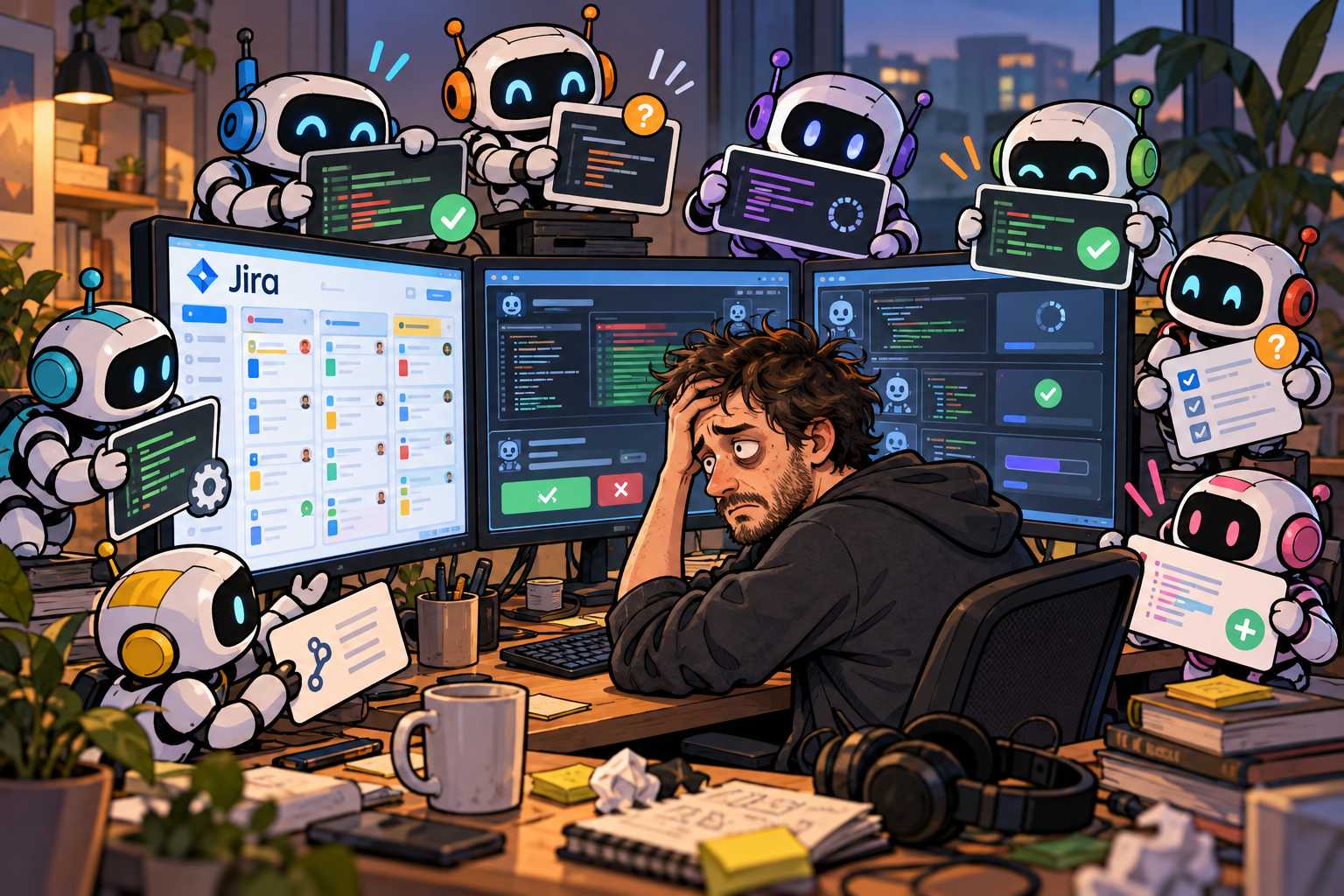
During a retrospective, a developer said that AI was taking the joy out of programming for him. That got me thinking.
I enjoy programming. I like immersing myself in a problem, working in a state of flow, and trying different approaches until a solution emerges where everything fits together.
Coding agents change that rhythm. You hand off a task and wait. Meanwhile, you start something else. Then the agent finishes, and you have to mentally switch back. The more things you work on in parallel, the more context switching you face.
What can get lost along the way is the chance to dive deeply into a problem. How carefully do you still review the results when the next task is always waiting?
The “Condom between Claude and Prod” meme is spreading among developers online: the agent delivers code, and your role is reduced to preventing it from going straight into production.
That leaves me wondering: what will software development look like after 2026?
I am seeing various approaches that I find interesting. In a social media video, one developer described how she enjoys working on her own side projects with AI, while at work she has lost that enjoyment completely. On her own projects, she can try out ideas, change direction, and shape things herself. At work, she copies fully specified tickets into the agent. For her, little of the creative work remains.
I can relate to that. Understanding a problem, exploring solutions, and making my own decisions are a big part of what makes development enjoyable for me. When most of what remains is oversight and context switching, something that drew many people to this work is missing.
This is where I find the idea of the Forward Deployed Engineer interesting: working closer to users, understanding their workflows, and taking broader business problems through to an outcome. Developers help shape requirements, solution design, and implementation.
Another approach is Software Factories. Agents could handle implementation, tests, and reviews in one continuous workflow. Developers would set the direction and review results at clearly defined points, instead of constantly switching between agent sessions.
Greater responsibility requires changes to the organization and its structures. We need to question old roles and processes and make time for conversations and focused thinking. An ever-growing number of parallel tasks could consume that space again.
I do not have a definitive answer yet. At the same time, the possibilities offered by AI are evolving incredibly fast. We will therefore need to keep questioning how we work. To me, asking what we enjoy about our work belongs in that conversation just as much as the potential time savings.
Which approaches are you trying? What helps you work productively with AI while keeping the joy of development?