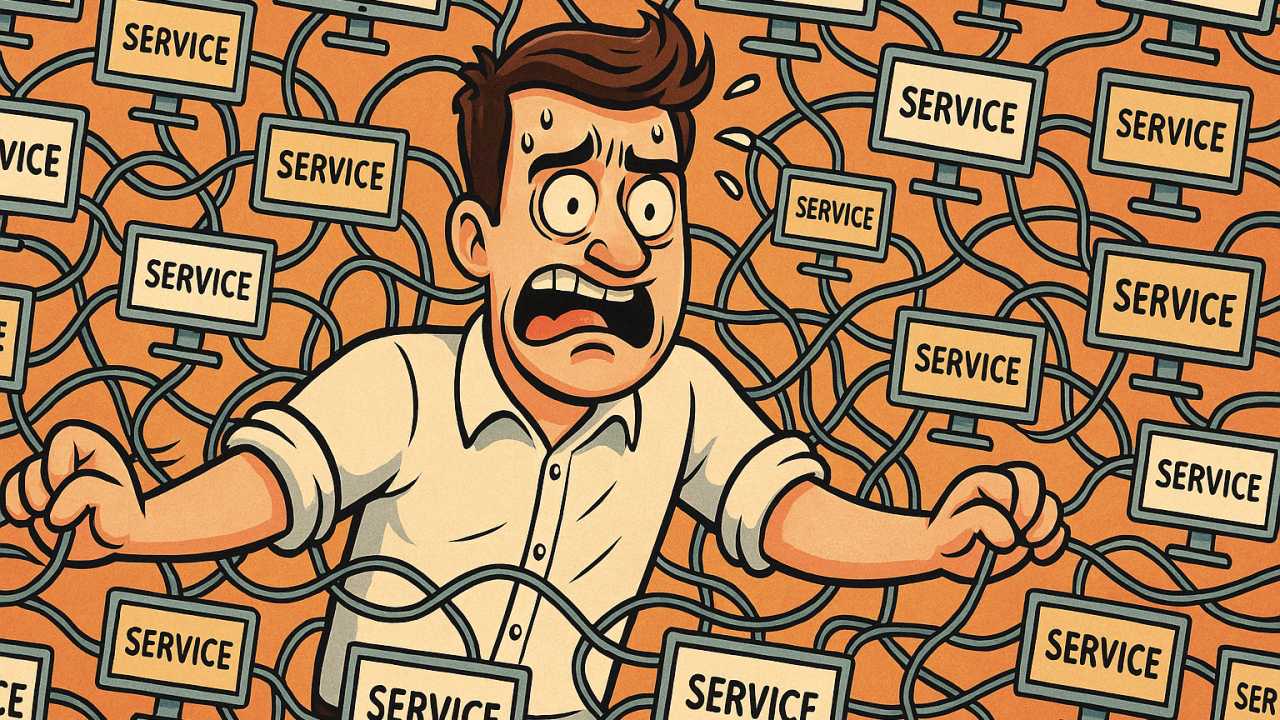
A common criticism of microservices is: more services = more maintenance effort.
That is fundamentally true: every deployable unit must be maintained, monitored, and updated. Distributed systems bring challenges that monolithic applications do not have.
In practice, however, I have seen both:
Teams of 15 developers reliably operating more than 50 microservices. Teams of the same size that were overwhelmed by a simple client-server app.
Experience shows that effort is not directly proportional to the number of services. It can grow exponentially or progress sublinearly. Organization, technology, and discipline are what matter.
1. Technological Consistency
A central factor influencing the maintenance effort of a microservice landscape is technological diversity. If every service is written in a different programming language, uses a different framework, or is based on its own database technology, complexity inevitably increases. Each additional technology brings its own expertise, toolchains, security requirements, and update cycles.
Recommendation:
Use the same technologies and frameworks wherever possible. Define clear standards for logging, monitoring, authentication, etc. Allow deviations only when they are technically necessary (e.g., performance-critical components).
Technological consistency creates synergies, but it also reduces flexibility. This is a classic trade-off.
2. Dependencies and Frameworks
A large portion of the maintenance effort in microservice architectures comes from dependencies on frameworks and libraries. Every piece of software must be updated regularly to close security vulnerabilities, use new features, or ensure compatibility. If every service brings its own dependencies, this effort multiplies. Every update, security patch, and breaking change may have to be evaluated and tested separately for each service.
This work can quickly consume a large share of development time, especially when dozens of services in different technology stacks have to be maintained. Still, proven strategies can reduce this work or automate it more selectively:
Fewer dependencies Centralized dependency management Automated testing Automated dependency management
3. Recurring Configuration and Infrastructure Dependencies
From authentication and database access to logging and monitoring, many services repeatedly have to perform the same tasks. If each of these functions is developed and maintained separately, maintenance effort quickly becomes substantial.
This raises the classic question: “Copy & Own” or reuse?
Should every service have its own implementation, or should you build centralized libraries that can be reused?
Both approaches have their place:
Copy & Own: maximum independence and simple refactoring per service, but a great deal of duplicated work and increased maintenance effort. Modern coding agents can make changes significantly faster today—for example, by making a change manually once and then transferring it to other services with AI-assisted tools. Reuse: saves development time and ensures consistency and quality standards, but leads to tighter coupling. Changes to a centralized library can cause unexpected side effects across many services.
The key is to standardize deliberately. Services should have as few special cases as possible: the more exceptions there are, the more complex shared libraries become.
Monorepos are a powerful lever for efficiency. They promote code reuse, shared toolchains, and standardized CI/CD pipelines. They do create a degree of coupling, but especially for smaller teams, the benefits outweigh it: changes can be made centrally, and tests or builds can be coordinated across all services.
Nx has proven particularly effective in the Node.js ecosystem. It provides centralized dependency management, incremental builds, caching, and dependency visualization. This creates an architecture that behaves like a modular monolith while retaining the flexibility to deploy individual services independently.
Used correctly, this approach significantly reduces operational effort and provides a robust foundation for reliably operating many services with limited manpower.
4. Dependencies Between Components
A decisive factor in the maintainability of a service landscape is how dependent its individual components are on one another. If I have ten services, but deploying any one of them works only when all the others are updated as well, I lose the benefits of a microservice architecture. In that case, maintenance effort grows not linearly but exponentially; every small change triggers a cascade of modifications.
This is essentially the same problem found in classic monolithic applications: the dreaded “Big Ball of Mud,” an opaque tangle of tightly interwoven modules. In such systems, every seemingly small change to one component causes unpredictable side effects elsewhere. Eventually, managing this complexity requires a disproportionate amount of time, testing effort, and capital.
Clear interface contracts and consistent decoupling provide a remedy. Every service should be functional and testable on its own. Communication between services should always be treated as a contract, not as a technical shortcut. API versioning, asynchronous events instead of synchronous dependencies, and the deliberate use of “backwards compatibility” are crucial here.
When services keep their interfaces stable and interact only through defined channels, the system remains flexible and manageable, regardless of how many services it ultimately contains.
5. Processes and Pipelines
Build, test, and deployment processes are often underestimated.
The most expensive option, of course, is having no pipeline at all. If deployments are performed manually or code is not tested automatically, effort increases with every additional artifact. As soon as multiple services need to be maintained and released, this quickly becomes a bottleneck.
Automation is the key here, but it also comes in different levels of maturity, each with its own advantages and disadvantages:
Every pipeline is unique Reusable and parameterized pipelines Monorepos as efficiency multipliers
It is important that automation does not become an end in itself. Ultimately, a complex pipeline that no one understands or can maintain is just as expensive as manual deployments. The goal should always be to balance reusability, transparency, and stability.
Ultimately, the more services you operate, the more important it is for the path from code to deployment to be consistent, reproducible, and automated. That is the only way to operate a microservice landscape efficiently over the long term with limited manpower.
Conclusion
The maintenance costs of microservices depend not on their number, but on architecture and discipline.
With consistent technology, clear interfaces, and good automation, a distributed system can be less expensive to operate than a monolith.
Discussion
Which methods have proven effective in your team for making the maintenance and development of service landscapes more efficient?